
Bed bugs are harder to eliminate than dust mites because they hide in tiny crevices near sleeping areas, are nocturnal, and can survive for months without feeding due to metabolic slowdown dust mite bites vs bed bugs. Their tough exoskeleton offers strong resistance to pesticides, plus they reproduce rapidly with clustered eggs that are harder to reach and treat. Dust mites, in contrast, are mostly stationary and thrive in humid bedding conditions. Understanding these differences helps clarify why bed bugs require more rigorous, targeted control methods.
Differences in Habitat and Behavior
Although both bed bugs and dust mites are common household pests, their habitats and behaviors differ markedly, affecting how you can manage them. Bed bugs exhibit strict nocturnal activity, emerging from crevices at night to seek blood meals, which makes detection and eradication more challenging. They prefer microclimates characterized by warmth and proximity to human hosts, often hiding in mattress seams and furniture joints. Dust mites, in contrast, thrive in humid microclimates within bedding and upholstered furniture, feeding primarily on skin flakes rather than blood. Their continuous presence https://igreenasia.com/, rather than nocturnal bursts, allows for different control strategies focused on humidity reduction and regular cleaning. Understanding these distinctions in habitat and behavior empowers you to apply targeted interventions, ultimately enhancing your control efforts and preserving your living space’s freedom from these pests.
Survival Mechanisms and Resilience
Because bed bugs possess remarkable survival mechanisms, they’re especially more resilient than dust mites when it comes to elimination efforts. Their cuticle toughness provides a durable protective barrier, shielding them from many chemical treatments and physical removal methods. This exoskeleton minimizes water loss and resists penetration by pesticides, making standard eradication techniques less effective. Additionally, bed bugs can undergo metabolic slowdown during periods of starvation or environmental stress, allowing them to survive for months without feeding. This physiological adaptation greatly extends their endurance, enabling them to evade elimination even in harsh conditions. In contrast, dust mites lack such robust defenses, making them comparatively easier to control. Understanding these survival traits is essential for you if you aim to achieve lasting freedom from bed bug infestations.
Reproduction Rates and Population Growth
Beyond their resilience, bed bugs’ ability to rapidly reproduce greatly contributes to the difficulty of controlling their populations. Each female bed bug can lay up to 5 eggs per day, accumulating hundreds within weeks. This rapid reproduction is facilitated by egg clustering, where females deposit eggs in tight groups, often hidden in crevices, enhancing survival rates. The clustered eggs are resistant to environmental stressors, allowing populations to expand swiftly. As you attempt eradication, this exponential population growth means that even a small number of survivors can repopulate an area quickly. Unlike dust mites, whose reproduction is slower and more dispersed, bed bugs’ reproductive efficiency demands rigorous, sustained intervention to prevent resurgence and regain control over your living environment.
Challenges in Detection and Identification
You won’t always spot bed bugs easily because their visual signs can be subtle and often confused with other pests. Their nocturnal behavior means they avoid detection during the day, making identification even harder. Understanding these factors is vital for effective monitoring and control.
Visual Signs Differentiation
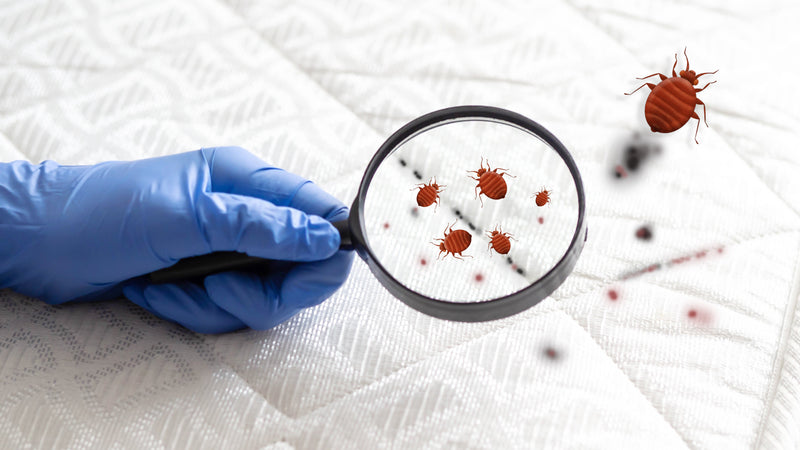
Although both bed bugs and dust mites are tiny pests, distinguishing between them based on visual signs can be challenging due to their size and habitat preferences. You’ll notice bed bugs often leave distinct stain patterns—small rusty or reddish spots caused by crushed bugs or their excrement—on bedding or furniture. In contrast, dust mites don’t produce visible stains but might contribute to dust accumulation. Shed skins are another key indicator; bed bugs molt several times, leaving behind recognizable translucent exoskeletons that you can spot near seams or crevices. Dust mite shed skins are microscopic and rarely visible without magnification. Understanding these subtle visual cues helps you identify infestations accurately, enabling you to target treatment effectively and maintain your freedom from persistent pest issues.

Behavioral Patterns Impact
Since bed bugs and dust mites exhibit distinct behavioral patterns, their detection and identification present unique challenges. You’ll find that bed bugs engage in nocturnal movement, actively seeking hosts under the cover of darkness, which complicates direct observation. Their reliance on aggregation signals allows them to cluster in hidden crevices, making visual detection difficult without specialized equipment. In contrast, dust mites remain largely stationary within bedding and upholstery, feeding on skin flakes without producing aggregation cues. This behavioral divergence means you must adapt your approach: detecting bed bugs requires nocturnal inspections and attention to subtle signs of clustering, while dust mite presence is inferred through environmental conditions rather than movement patterns. Understanding these behavioral nuances is essential for effective identification and control strategies that preserve your freedom from infestation.
Effectiveness of Common Control Methods
You’ll find that chemical treatments often face resistance from bed bug populations, reducing their overall efficacy. Environmental controls like heat or vacuuming have limitations in reaching all hiding spots and life stages. Understanding these challenges is key to developing more effective elimination strategies.
Chemical Treatment Challenges
When dealing with bed bugs, you’ll find that many common chemical treatments fall short due to the pests’ growing resistance and elusive behavior. Bed bugs have developed significant pesticide resistance, rendering many traditional insecticides less effective over time. This resistance stems from genetic adaptations, allowing them to survive doses that once ensured eradication. Furthermore, application variability complicates treatment success; inconsistent or incomplete pesticide coverage can leave hidden populations untouched, enabling rapid resurgence. Unlike dust mites, bed bugs hide in tiny crevices, making thorough chemical penetration difficult. As a result, relying solely on chemical methods often fails to provide the freedom from infestation you seek. Understanding these challenges essential for selecting integrated approaches that address both resistance mechanisms and application precision to achieve lasting control.
Environmental Control Limitations
Beyond chemical treatments, environmental control methods also face significant limitations in effectively managing bed bug infestations. You might think manipulating temperature regulation or humidity control would suffice, but bed bugs exhibit remarkable resilience. While exposing infested areas to extreme heat above 45°C can kill them, maintaining such temperature uniformly is challenging without professional equipment. Similarly, reducing humidity levels alone won’t eradicate bed bugs, as they tolerate a broad range of moisture conditions. These pests hide in crevices, making it difficult for environmental adjustments to reach all hiding spots. Consequently, relying solely on environmental control limits your ability to achieve total elimination. For true freedom from bed bugs, you’ll need an integrated approach combining targeted chemical treatments with precise environmental strategies.
Professional Treatment Options and Strategies
Dealing with bed bugs often calls for more than DIY methods because these pests have developed resistance to many common treatments. To regain control, professionals deploy integrated management combining inspection, chemical, and non-chemical tactics. Targeted fumigation is one precise strategy, penetrating hiding spots to eradicate infestations effectively. When choosing treatment, consider these core options:
- Heat treatment elevates temperatures above 120°F to kill all life stages.
- Targeted fumigation uses gas or vapor to reach inaccessible areas.
- Chemical insecticides apply residual or contact toxins strategically.
- Integrated management blends these approaches, optimizing efficacy while minimizing resistance.
Conclusion
You’ve seen that bed bugs are harder to eliminate than dust mites due to their elusive habitat, strong survival mechanisms, and rapid reproduction. Unlike dust mites, bed bugs hide effectively and resist common treatments, making detection and control challenging. To successfully manage infestations, you’ll likely need professional intervention employing targeted strategies. Understanding these differences helps you approach pest control with precision, ensuring more effective and lasting results.